Real Money Online Poker Sites: Best Poker Apps for US Players

Online poker looks different depending on your zip code. California and Florida have no regulated real-money market, Nevada runs its own licensed site, and Arizona restricts play mostly to tribal land, so offshore poker rooms fill the gap for most of the country.
This guide breaks down what’s actually legal for online poker in California, Florida, Nevada and Arizona, which offshore sites take real money from each state, and how bonuses, rakeback, and withdrawals work once you sit down at a table.

















Best Online Poker Sites for US Players: California, Florida, Nevada & Arizona
The best online poker sites for California, Florida, Nevada, and Arizona players share three traits: fast crypto withdrawals, real tournament liquidity, and a bonus that clears through actual play instead of landing as a single credit. That last part matters more than most new players expect. A $2,000 welcome offer sounds identical to a $500 one until you compare how each one releases.
CoinPoker

CoinPoker pairs crypto-fast payouts with one of the deepest tournament calendars available to US players. The 2026 client processes most withdrawals in minutes, with a stated window up to 72 hours for select methods, and the 150% welcome bonus up to $2,000 clears through poker fees rather than casino wagering. Sunday majors like CoinMasters BITCOIN carry a $250,000 guaranteed prize pool, and the CoinRewards system pays a 15% daily rate on top of weekly CoinRaces. Play is priced primarily in USDT, so a crypto wallet ready to go makes the whole experience smoother.
Verdict: CoinPoker is the strongest pick for crypto-native players who want modern software, serious tournament guarantees, and rewards that pay out daily.
ACR Poker
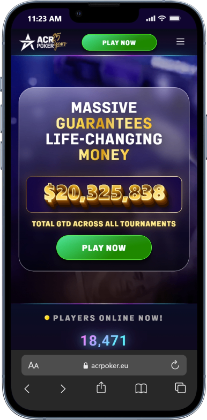
ACR Poker delivers the deepest US-facing tournament schedule of any offshore room, with weekly guarantees above $9.2 million. The Winning Poker Network skin has run since 2001, and its Online Super Series XL carries a $50 million guarantee alongside a packed daily schedule. The $2,000 welcome bonus releases in $1 increments per 27.5 Award Points over 60 days, and crypto withdrawals typically land within a few hours to a few days depending on method. Players can choose a flat 27% rakeback deal or the tiered Elite Benefits program instead.
Verdict: ACR Poker is the pick for tournament grinders who want the biggest US-facing prize pools and real rakeback value.
Stake.us
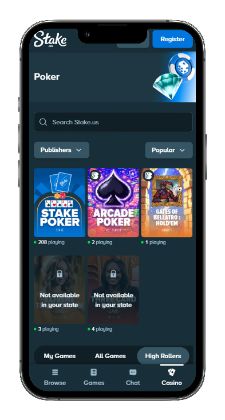
Stake.us runs a genuine social poker room where prize redemption works through Gold Coins and Stake Cash instead of a cash deposit. New players get 250,000 Gold Coins and 25 Stake Cash, plus daily top-ups for 30 days, and the wagering requirement on Stake Cash sits at a low 3x. Daily freerolls guarantee $500 or more in Stake Cash, and the poker product runs on Evenbet software across Hold’em, Omaha, and Pineapple. Redemptions clear in about 15 minutes once approved, with total processing commonly finishing within four days.
Verdict: Stake.us is the best option if you want real poker action without a traditional cash deposit.
Is Online Poker Legal in California, Florida, Nevada & Arizona?
Nevada is the only one of the four states with a regulated, licensed online poker market. California, Florida, and Arizona have no state-regulated real-money poker network, which means players there rely on licensed offshore sites instead of a state-approved platform. That single gap shapes bonus structure, withdrawal speed, and game selection everywhere else in this guide.
Is Online Poker Legal in California?
No state law currently authorizes a regulated real-money online poker market in California. Bills have reached the state legislature more than once over the past decade, largely stalled by disagreements between tribal gaming interests and commercial cardrooms. Is online poker legal in California through an offshore site? Yes, and that’s the route almost every real-money player in the state actually uses.
Is Online Poker Legal in Florida?
Florida’s gaming compact with the Seminole Tribe covers sports betting and mobile wagering tied to tribal servers, not standalone poker. There’s no regulated real-money poker network operating in Florida under that compact. Is online poker legal in Florida in the same offshore sense as California? Yes, the same licensed offshore rooms serve both states.
Is Online Poker Legal in Arizona?
Arizona legalized mobile sports betting in 2021, but that framework never extended to cover online poker in Arizona. No regulated market exists in the state yet, and there’s no pending legislation that changes that picture soon. Is online poker legal in Arizona through licensed offshore sites? Yes, and Arizona online poker traffic runs almost entirely through that channel today.
Enforcement in every unregulated state has historically targeted operators, not the individual signing up from a laptop at home. Nobody has been prosecuted for depositing at a licensed offshore poker room from California, Florida, or Arizona. The practical distinction between states comes down to this:
- Nevada: regulated online poker through licensed, state-approved platforms.
- California: no state regulation; offshore sites cover the real-money gap.
- Florida: no state regulation; offshore sites cover the real-money gap.
- Arizona: no state regulation; offshore sites cover the real-money gap.
Pros and Cons of Offshore Online Poker Sites
Offshore online poker sites solve a real access problem. They’re the only route to real-money multiplayer poker in states without a regulated market, and for California, Florida, and Arizona players, that’s the whole ballgame. The tradeoffs are worth understanding, though none of them are dealbreakers once you pick a well-established room.
Pros
- Access: real-money multiplayer poker in states with no regulated market, including California, Florida, and Arizona.
- Bonus size: welcome offers commonly reach $1,000 to $3,000, above what many single-state regulated networks offer.
- Crypto speed: Bitcoin and other crypto withdrawals often clear within an hour to 24 hours.
- Game variety: fast-fold formats, mixed games, and high-guarantee tournament series alongside standard cash tables.
Cons
- Licensing sits with jurisdictions like Curaçao, Panama, or Anjouan rather than a US state regulator, so dispute resolution runs through the operator instead of a state gaming commission.
- Welcome bonuses clear through rake or points over a set window, commonly 30 to 60 days, rather than landing as an instant credit.
- Choosing a room with a long operating history carries more weight than it does in a regulated market, since there’s no state license confirming baseline consumer protections up front.
Playing Poker for Free & With Friends: Nevada’s Vegas-Style Tables
Free online poker in Nevada runs through sweepstakes-style platforms and play-money tables, giving you the Vegas poker room feel without a cash buy-in. Stake.us is the clearest example. Its Gold Coins let you sit down at Hold’em, Omaha, or Pineapple tables for free, and Stake Cash earned alongside them can be redeemed once the low 3x wagering requirement clears.
Free Vegas poker online through this model works well for practicing formats you haven’t played before, or for friends who want to sit at the same virtual table without anyone risking real money. Poker online Vegas players who want the social element without the stakes get daily freerolls with $500-plus guaranteed prize pools on Stake.us, a genuine tournament structure rather than a stripped-down demo mode.
Vegas poker online through a licensed sweepstakes site also sidesteps the regulated-vs-unregulated question entirely, since no cash deposit changes hands for the play itself. Online poker fans who eventually want real-money stakes can move to Nevada’s regulated network or an offshore room once they’ve found the format they like.
Video Poker & 3-Card Poker: How They Differ From Multiplayer Poker
Video poker and 3-card poker are single-player casino games played against a paytable or the house, not against other people. There’s no bluffing, no opponent to read, and no rake taken from a pot, because there is no pot shared between players. You’re simply comparing your final hand against a fixed payout table or the dealer’s hand.
Multiplayer poker, the kind covered everywhere else in this guide, works completely differently. You’re playing against other real players, the site takes a rake from the pot or a tournament fee, and skill in reading opponents matters as much as the cards themselves. Stake.us lists Video Poker alongside its multiplayer Hold’em, Omaha, and Pineapple tables, which is a useful illustration of how the two categories sit side by side on the same platform without being the same game. If a search for “online poker” was really about the video poker machine feel, a casino’s video poker section is the right place to look. If it’s about playing hands against real opponents, multiplayer cash games and tournaments are the category that applies.
How to Fund Your Online Poker Account
Crypto funds an online poker account faster than any traditional method, both in and out. That single fact drives most of the banking decisions serious players make across every state covered here.
| Method | Deposit Time | Withdrawal Time | Fees | Availability |
|---|---|---|---|---|
| Crypto (Bitcoin, etc.) | Instant to a few minutes | Under an hour to 24 hours | Network fees apply, vary by coin | Available in all states covered here |
| E-wallets/vouchers (e.g. MatchPay) | Usually instant | 1 to 2 business days | Typically none | Depends on the site |
| Bank transfers and checks | 1 to 3 business days | 10 to 15 business days | Processing fees may apply | Broadly available across states covered |
| Credit and debit cards | Instant on most sites | Not typically supported | Issuers can add a cash advance fee | Widely available |
Crypto’s speed advantage comes from cutting the bank out of the loop entirely. A Bitcoin withdrawal moves peer to peer once the site approves it, while a check has to physically print, mail, and clear. The tradeoff is familiarity: crypto requires setting up a wallet and understanding network fees, which is a small learning curve traditional banking doesn’t ask for. For a first deposit, most players still find card or bank transfer easier to understand, then switch to crypto once withdrawal speed becomes the priority.
Mobile Apps vs. Browser Play
Online poker players choose between native mobile apps and browser-based play depending on the site, and both routes give full access to cash games and tournaments. CoinPoker’s 2026 materials describe a dedicated iOS and Android app with full cashier and game access, matching desktop feature-for-feature. BCPoker also runs native iOS and Android apps supporting multi-tabling up to four tables at once.
Other rooms take the browser-first route instead. Ignition offers mobile browser support with near-full feature parity versus desktop but no dedicated app, and Jack Poker runs a native Android app while iOS users access the platform through mobile web. Online poker in Las Vegas and across the rest of Nevada works fine either way. A browser-based site loads instantly with no install step, while a native app tends to run a touch smoother during long multi-tabling sessions. Online poker rewards whichever format matches how you actually play: quick sessions favor the browser, serious grinding sessions favor a dedicated app.
Skill, Strategy & the ‘Is It Rigged’ Question
Online poker is not rigged on licensed, audited platforms, and the fairness mechanics behind that claim are checkable rather than taken on faith. Shuffle algorithms on reputable sites go through independent testing, and platforms like CoinPoker point to blockchain-backed fairness as a way to make the shuffle verifiable rather than a black box. BCPoker’s BC Shield suite adds AI-powered bot detection and liveness checks specifically aimed at catching automated play and collusion, which is the real threat to game integrity, not a rigged deck.
Skill matters more in poker than in any other game covered in this guide, because you’re playing against other people’s decisions, not a fixed house edge. Bankroll management and starting-hand discipline separate long-term winners from long-term losers far more than any single hand’s luck.
- Keep at least 20 buy-ins in reserve for the stakes you’re playing.
- Move down in stakes the moment your bankroll drops below that buffer.
- Play tighter from early position, looser from late position.
- Track your results by session, not by hand, to see real trends.
- Avoid tables where you can’t identify at least one weaker player.
Responsible Gambling
Responsible gambling tools work best when you set them up before a session starts, not after a losing streak begins. Every reputable poker site offers deposit limits, session time reminders, and self-exclusion options somewhere in the account settings, and turning them on takes a few minutes.
Warning signs worth watching for include chasing losses with bigger buy-ins, playing stakes that stretch your bankroll past comfortable limits, and spending more time at the tables than you’d planned. None of these mean you have to stop playing. They mean it’s time to set a limit and stick to it.